Chocoa: Days 1-2

Chocoa is an international chocolate conference held in Amsterdam, Netherlands, every February, whichever season that means for you (be it in Japan, where it's the height of winter, or in Rio de Janeiro, where it's the peak of summer).
When I first heard of this conference, I honestly thought it was a joke. I would never have imagined my thirteen-year-old self being plunked down in the midst of professionals who'd been working for twenty-plus years. The scene, I thought to myself, would be like a crayon drawing in the corner of a Van Gogh or Picasso.
In hindsight, I think I handled myself well, aside from the omnipotent jetlag that afflicted me these first few days. As a result, this post intends to cover as thoroughly as I can the first two days of six spent in Amsterdam, in spite of my somewhat patchy memories of that time period.
It's also worth mentioning that accompanying me on this voyage was Anne, who has made several appearances in my stories beforehand. She owns a farm in Hawai'i (that farms cacao, among other crops), and she's been an invaluable asset and mentor to me along my journey.
The first day was mostly just us getting into the conference, checking in, and making sure everything was functioning. So I won't be including that in the total and we'll call it Day 0.
Day 1 started with a lecture on cacao bean pricing and what drives it, as well as how to predict where it may go. It was a very analytic lecture, and there were a lot of factors that the speaker included: how fluctuating prices outline advantages for either side, how the cacao bean is an annual crop and therefore demand increases some specific times of the year, how supply had control over demand and how that could potentially make any problem into inflation.
There was a lot of other insignificant events that happened that first day, for example me watching the organizers set up the conference floor, and the next important event by a long shot was the WINCC (Women In Cocoa and Chocolate Network) event, where I did some networking. I met a group of three ladies who collectively presented me with a brilliant idea:
First, some context: I've been considering launching a product line, and the way it might work is that I'd formulate a couple "recipes" using beans from Anne's farm. These recipes would then be sent to Anne's maker, called Daisy, and as they'd all be with Anne's beans, I'm sure Daisy could handle them fine. These chocolates would then be sent back to me and I would sell them.
Now, this idea the ladies gave me, it focuses around the idea of a USP, or "unique selling proposition". A product or service must have something about it that accomplishes several things: it must make the product or service clearly stand out; it must outline a reason for a potential customer to purchase it; it must catch one's eye and make them think. Maybe I threw in that last one, but it makes sense to me.
Essentially, the idea revolves around the fact that I know Anne, and I know Daisy. My father also happens to know the CEO of a date-farming company, so I can get sugar from there. What this all means is that I can compress the supply chain into a tightly packed parcel where I know exactly where and how each of my ingredients is being made. This also means that I can claim my product has "complete transparency" because I have the unique ability to tell someone exactly where everything happens and who does it. Each step of the way can be carefully tracked, and this allows me to control with utmost precision the outcome.
So this concept could supposedly be used as a USP, and therefore I would have the baseline requirement for a product line of chocolates.
Anyways, the next day saw me meeting Bhavani Veerapaneni, the founder of Diamond Custom Machines, who had given a talk at the Northwest Chocolate UnConference last year. His seminar was by far the most useful to me, and I talked with him for some time about the ideal spacing between wheels of a melanger and the base. It's about 50 pounds, and the reason this concept of exact spacing exists in the first place is that if the wheels and base are too close together, then the solids will not go through them but instead around and will not refine enough. Conversely, if they are too far apart, then the particles will not be crushed enough and the result will be under-refined.
We also talked a little about how importing prices are really high, especially for machinery. As I've shown you earlier, cacao's price fluctuates dramatically, but cacao is only one part of the equation. Labor, machinery, sugar (if you're using it), and other ingredients like cocoa butter, soy lecithin (which is an emulsifier that reduces viscosity), and additions.
That's about everything important that happened on the first two days, and the next post will be about the last days and the show floor.

This is me on the floor, when they were setting up. This would be the Cacao of Excellence's booth, where entrants send in beans, and the committee roasts them and makes chocolate to be judged.
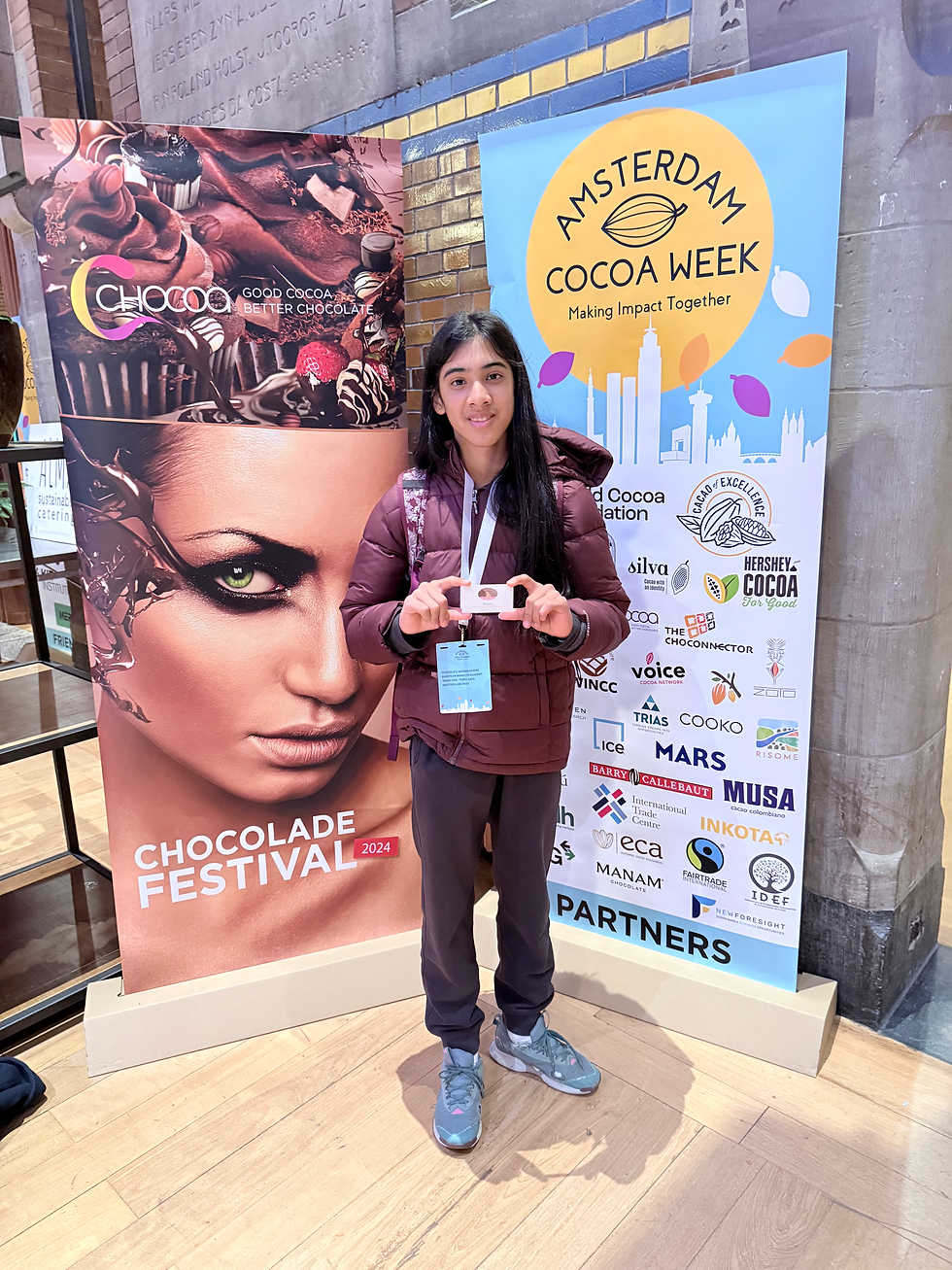
This is what everyone would see when they walked into the Beurs van Berlage conference center: these two banners (Displays? Posters? I don't really know). The card I'm holding has all of my info on it: my blog, my email, and a couple other things. You, the reader, doesn't need one, because you're already here.


Comments